

Ducted Air Conditioning and Solar Panels in Logan - ClimateLink Pty Ltd
Home » Ducted Air Conditioning and Solar Panels in Logan: How to Run Your Whole Home on Sunshine Ducted Air Conditioning and Solar Panels in Logan: How to Run Your Whole Home on Sunshine Logan has one of the highest rates of residential solar uptake in South East Queensland. So it’s no surprise that one of the most common questions we hear is; “Can solar panels and ducted air conditioning work together?” Quick answer: Yes. A standard 6.6kW solar system in Logan typically produces 25 to 35kWh per day, enough to cover the majority of a 10kW to 14kW Daikin ducted system’s daytime usage.
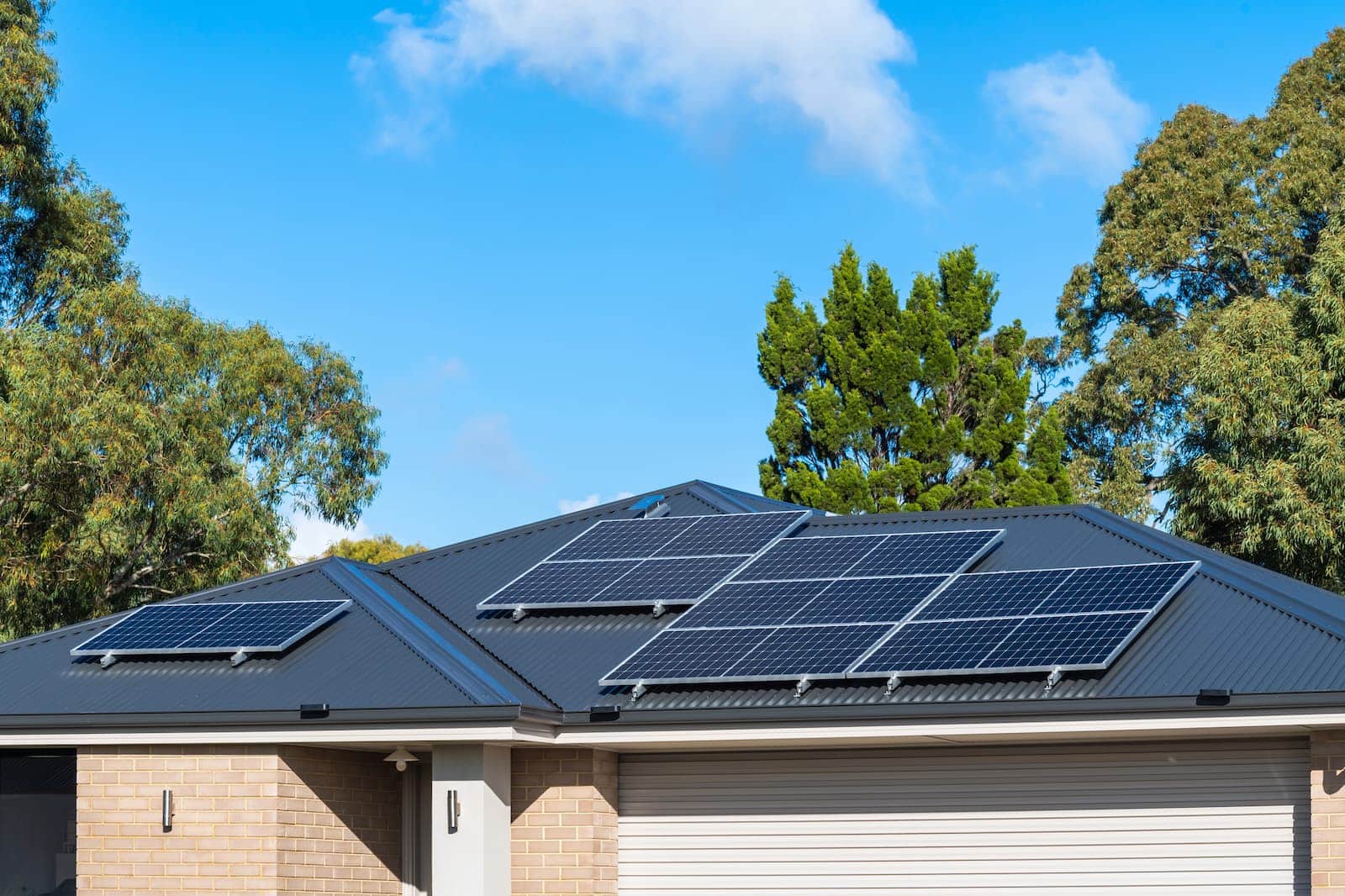
Pairing that system with Advantage Air iQ Solar Mode can reduce grid reliance by up to 40%, by automatically pre-cooling your home during peak generation hours. Drive through Yarrabilba, Greenbank, Browns Plains or Regents Park on a sunny February afternoon, when the humidity rolls in off the ranges and the Logan Motorway corridor shimmers with heat haze, and the rooftops tell the story. Panels everywhere.
A Common Misconception
A ducted AC system doesn’t connect to your solar hardware in any special way. There’s no dedicated solar circuit needed, no special inverter, and no solar-specific wiring configuration. It simply becomes another load on your home’s normal electrical supply, the same as your dishwasher or your pool pump.
What happens in practice is straightforward. While your panels are producing, that power offsets whatever your home is drawing. Your Daikin ducted system pulls from solar first and the grid fills in only when generation falls short.
The system has no idea it’s running on sunshine, and it doesn’t need to. We bring this up because a surprising number of homeowners come to us thinking they need to upgrade their solar before they can install ducted AC. In most cases, they don’t.
Your existing setup will work just fine as a starting point.
Running Ducted AC on Solar: Will It Cover Your Costs?
This is where accurate information really matters, because the numbers vary significantly depending on which system you install and how hard it’s working at any given moment. Daikin’s residential inverter ducted range covers a wide capacity band suited to different home sizes. At rated cooling conditions, a Daikin 10kW inverter ducted system draws around 3.1kW of power input.
The 16kW Premium Inverter (FDYA160) draws a rated 4.85kW during cooling. The larger 20kW system draws around 6.11kW at rated load. Those are peak figures, though.
Because every Daikin in our range uses inverter technology, the compressor continuously adjusts its speed to match the actual cooling demand in your home. Think of it like cruise control in a car. On a mild morning with only a couple of zones open, a 14kW system might draw 1.5 to 2kW.
On a 35°C Logan afternoon with the whole house running, it climbs toward the rated figure. This modulating behaviour is exactly what makes inverter systems so well suited to solar homes, because the draw rises and falls in rough proportion to available generation throughout the day. A 6.6kW solar system, which is one of the most common sizes across Logan, will typically produce 25 to 35kWh on a clear summer day.
For a 3 to 4 bedroom home running a Daikin 10kW to 14kW system, solar generation will cover the large majority of daytime AC usage. Here’s how that translates to actual running costs: Cooling Method and Solar Setup Estimated Daily AC Cost Daikin 10kW ducted, 6.6kW solar, clear day $0.80 to $2.00 Daikin 10kW ducted, grid only $8.00 to $14.00 Daikin 14kW ducted, solar with iQ Solar Mode $0.20 to $1.50 Single split system, grid only $3.50 to $6.00 Based on typical SE Queensland summer conditions and current Energex network rates. Results will vary by home, insulation and zone usage.
Which Daikin System Suits Your Logan Home?
Getting the size right is the single most important decision in the whole process. An undersized system runs flat out and never quite catches up on a hot day. An oversized system short-cycles and uses more power than the home actually needs.
Neither outcome is good for your solar bills. Here’s how the Daikin range maps to typical Logan home sizes: Home Size Recommended Daikin Capacity Rated Power Input (Cooling) 2 to 3 bed, single storey 10kW (FDYAN100) 3.1kW 3 to 4 bed, single storey 12.5kW to 14kW 3.8 to 4.2kW 4 to 5 bed or double storey 16kW (FDYA160) 4.85kW Large home or open plan 18kW to 20kW 5.09 to 6.11kW These are indicative figures. A proper site assessment is always the right starting point before committing to a system size.
As authorised Daikin specialists in Logan, we find the FDYA160 is often the sweet spot for double-storey homes, which are increasingly common in newer developments like Yarrabilba and the estates spreading out through the southern end of the corridor. The 16kW capacity handles the thermal load of a two-storey home on a Queensland summer day without pushing the system to its limits, which also means it spends more time at moderate inverter speeds, drawing less from the grid and more from solar. All Daikin ducted systems in this range use R32 refrigerant, which carries a Global Warming Potential 66% lower than the previously common R410A.
This matters for compliance with AS/NZS 5149 (Refrigerating systems and heat pumps — Safety and environmental requirements) and it’s something we hear increasingly from Logan homeowners who want their energy upgrade to be genuinely sustainable end to end. Every Daikin we install also exceeds Minimum Energy Performance Standards (MEPS) as required under Australian law, achieved through a DC fan motor, cross-pass heat exchanger design, and improved refrigerant control technology.
What About Home Batteries?
If you have a battery system, a ducted AC setup can absolutely draw from it, but it’s worth being realistic about the numbers. Using the Daikin 10kW as a reference, with a rated cooling input of 3.1kW, a 10kWh home battery running that system at moderate load with no solar input would be substantially depleted within 3 to 4 hours. For most Logan households, the practical approach is to use solar for daytime cooling and let the battery cover the early evening, after the sun drops but before the house has fully cooled down.
That’s the window where grid power would otherwise kick in, and where battery storage earns its keep most efficiently. Battery systems must comply with AS/NZS 5139:2019 (Electrical installations — Safety of battery systems for use with power conversion equipment), which governs safe installation and load integration. A correctly installed system handles your ducted AC alongside other household loads without any issues.
Running Ducted AC on Solar, the Smart Way: Advantage Air iQ
A standard ducted controller runs on a timer or thermostat. It doesn’t know what your solar panels are doing, which means it can quite easily kick on at full load during the least solar-productive part of the afternoon and draw heavily from the grid exactly when you’d prefer it didn’t. This is where Advantage Air iQ makes a real difference, and it’s one of the reasons we pair Daikin systems with iQ control wherever it makes sense for the homeowner.
The iQ system is developing a solar mode that detects when your home is exporting excess power to the grid and automatically ramps up cooling or heating to absorb that surplus. When generation drops, whether due to cloud cover, other appliances switching on, or the sun moving lower in the sky, iQ pulls back the AC output to match. Pre-cooling your home to 22°C by 1pm using surplus solar, then letting it drift naturally to 24°C over the afternoon, is a genuinely different financial proposition compared to fighting the heat on grid power at 5pm.
If you have a battery, iQ gives you direct control over how the system prioritises its energy use: Comfort first: iQ uses available solar to run the AC and lets the battery top up alongside Battery first: The battery charges to your preferred level before iQ ramps up cooling Smart throttle: iQ reads both solar output and battery state simultaneously, preventing unnecessary battery drain during periods of low generation We describe it to customers as a solar-smart thermostat built into your ducted controller. It doesn’t require any additional hardware integrations or third-party apps. From our work in the field: We helped a family in Browns Plains reduce their summer grid reliance by around 40% by switching their existing Daikin ducted system to iQ Solar Mode.
No new panels were added. No battery upgrade. Just smarter scheduling and automated pre-cooling timed to their peak generation window.
What Size Solar Do You Need for Ducted AC in Logan?
There’s no universal answer, but here are the guidelines we work from when advising customers across Logan and surrounds. If you already have a 6.6kW system: This is generally well-suited to a Daikin 10kW to 14kW ducted setup during daylight hours. If your panels are more than 7 to 8 years old, it’s worth checking actual output data, as generation capacity does degrade over time.
If you have a 3 to 5kW system: You’ll likely get good solar coverage during spring and autumn, but peak summer demand on a larger Daikin may outpace your generation on hot days. We’ll review your data with you before making a recommendation. If you’re planning solar alongside a new ducted install: We generally recommend a minimum 6.6kW array if ducted AC is part of the picture.
If you’re adding battery storage as well, 10kW or above is worth considering seriously. Under Clean Energy Council guidelines for accredited solar installers, system sizing is expected to account for all significant household loads, and ducted air conditioning is explicitly noted as a high-consumption load that should inform how a solar array is sized. Getting both systems sized relative to each other from the start avoids the situation where your solar is working hard to run the AC but never quite keeping up.
Common Questions from Logan Homeowners
Will ducted AC affect my solar warranty? Not at all. Your ducted system connects to your standard home electrical supply and has no interaction with your solar hardware.
The two operate completely independently. Do I need to tell my energy retailer? Not for adding ducted AC.
You would only need to contact your retailer if you’re changing your solar export arrangement or upgrading your solar inverter. Will I earn less from feed-in tariffs? Yes, you’ll export less because you’re using more of what you generate at home.
On virtually all electricity plans, usage charges are always higher than a solar feed-in tariff, meaning you save more money by using your excess solar instead of exporting it. Daikin Air Conditioning That gap is only widening as feed-in rates trend downward. Will I earn less from feed-in tariffs?
Yes, you’ll export less because you’re using more of what you generate at home. On virtually all electricity plans, usage charges are always higher than a solar feed-in tariff, meaning you save more money by using your excess solar instead of exporting it. Daikin Air Conditioning That gap is only widening as feed-in rates trend downward.
The Bottom Line
Solar and ducted AC work together naturally. The inverter technology in every Daikin we install means the system is already behaving in a solar-friendly way, drawing only what it needs and modulating constantly rather than hammering the grid with fixed-load cycling. Add Advantage Air iQ Solar Mode and your system becomes an active participant in managing your home’s energy, not just a passive load sitting on the supply.
Logan’s climate isn’t forgiving across summer, and whole-home comfort is a genuine priority for families here. If you’d like to understand how a Daikin ducted system would work with your existing solar setup, or how to size things properly if you’re starting from scratch, we’re happy to come out and assess your home at no cost. Call us on 1300 224 968 or request a free quote Search Search Recent Posts Why Do Ducted Air Conditioning Quotes Vary So Much?
Strange Air Conditioner Smells: What They Mean and When to Call a Pro Office Air Conditioning Installation: Considerations Before a Fit-Out How Long Does Ducted Air Conditioning Installation Take? How to Plan Commercial AC Installation Without Disrupting Staff or Customers A Guide to Commercial Air Conditioning Installation in Logan Family-owned and recognised for excellence, ClimateLink delivers trusted air-conditioning solutions across Logan and South Brisbane Quick link Home About Us Blog Gallery FAQs Contact Residential Ducted Air Conditioning Split Systems Smart Home Controlled Ventilation Residential Servicing Commercial Ducted Aircon Installation HVAC Maintenance Air Conditioning Repairs ClimateLink Pty Ltd 51 Dandaraga Ct, Chambers Flat, Logan QLD 4133, Australia 1300 224 968 Licenses QBCC 15381611 ARCTIC AU59501 ABN 86 668 220 193 Electric Lic 166448 © 2026 ClimateLink Pty Ltd. All Rights Reserved.
Website by MyWork
Want advice for your home?
The ClimateLink team designs and services ducted systems across Logan every day. Call 1300 224 968 or get a free quote.